Why SEO Matters More Than Ever
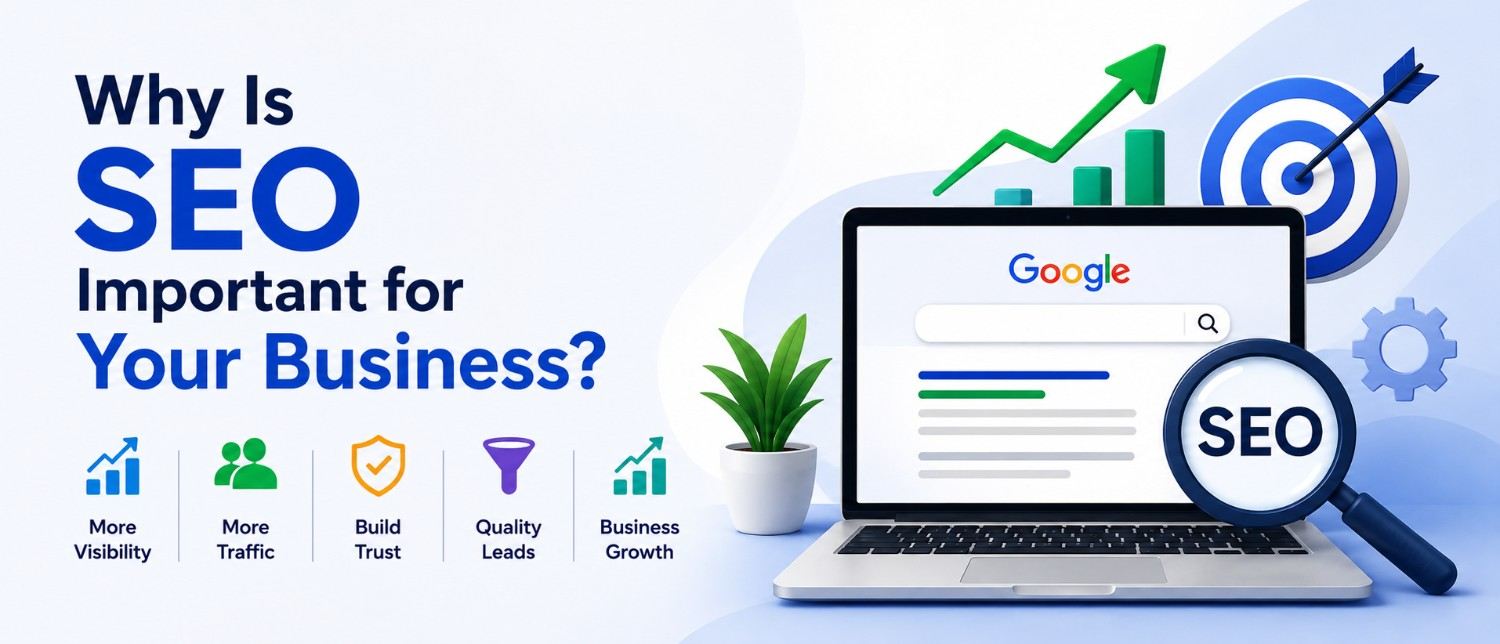
If potential customers cannot find your business online, they may never get the chance to choose your products or services. That is why search engine optimization has become a critical part of modern digital marketing. SEO helps businesses improve their visibility in search engines, attract relevant organic traffic, build trust, generate qualified leads, and create sustainable long-term growth.
Unlike paid advertising, where visibility can disappear when the budget stops, a well-executed SEO strategy can continue generating value over time. Simply put, your customers are searching online for solutions, and SEO helps your business appear when those searches happen.
What Is SEO and Why Does It Matter for Businesses?
SEO, or search engine optimization for businesses, is the process of improving a website so search engines can better understand its content and show it to relevant users. It involves keyword research, content optimization, on-page SEO, technical SEO, off-page SEO, backlink acquisition, local SEO, and user experience improvements.
The goal is not simply to rank for as many keywords as possible. Effective SEO for business focuses on attracting the right audience by understanding what people are searching for and matching that search intent with useful, relevant content. A person searching "digital marketing agency for small business" has different intent than someone searching "what is digital marketing," and a strong SEO strategy recognizes these differences at every stage of the customer journey.
Why Is SEO Important for Business?
The importance of SEO for business comes down to visibility and discoverability. Search engines process an enormous number of queries, and if your website does not appear for relevant searches, your competitors may capture those potential customers instead.
SEO helps businesses improve online visibility, reach users with relevant search intent, increase organic traffic, build brand credibility, generate qualified leads, improve website experience, and support long-term digital growth. The strongest SEO strategies focus on helping users first, aligning with Google's guidance around creating helpful, reliable, people-first content that meets technical requirements and follows spam policies.
1. SEO Improves Your Online Visibility
One of the biggest benefits of SEO is improved website visibility. When people search for services related to your business, appearing prominently in relevant results increases the chances they discover your brand. Without SEO, even an excellent website can remain difficult for potential customers to find.
SEO improves visibility by helping search engines understand what your business offers, which topics your website covers, and how your pages connect. A Hub and Spoke model helps here, letting a business build topical relevance by creating a comprehensive pillar page, such as a central hub around Digital Marketing, and connecting it with supporting articles about SEO, PPC, social media marketing, and local SEO.
2. SEO Drives Relevant Organic Traffic
Traffic alone is not enough. A website with thousands of visitors may still fail to generate leads if those visitors are not interested in the business, which is why relevant organic traffic is one of the most valuable benefits of SEO. SEO starts with keyword research and search intent analysis, focusing on searches connected to your products and services rather than random high-volume keywords.
A strong business SEO strategy targets a combination of top-of-funnel educational keywords that build awareness, middle-of-funnel keywords where users are researching solutions, and bottom-of-funnel commercial keywords where users are actively comparing services or providers. By creating content for each stage, businesses build a more complete organic acquisition funnel.
3. SEO Builds Brand Credibility and Trust
Appearing consistently in relevant search results can help increase brand awareness and credibility. If your brand repeatedly provides useful answers through blog posts, service pages, and guides, people become more familiar with your business before they are ready to convert.
Credibility is not built by rankings alone, it also depends on the quality of your website and content: accurate and useful information, clear expertise, original insights, well-structured content, and a positive user experience. The practical takeaway is simple: focus on creating genuinely useful pages rather than trying to manipulate rankings with shortcuts.
4. SEO Supports Lead Generation
For many businesses, the ultimate purpose of SEO is not simply ranking higher, it is generating qualified leads. If your website has a relevant, optimized service page that clearly explains your services, experience, process, and value proposition, a search visitor searching "SEO agency for small businesses" may become a lead.
A strong SEO landing page should include a clear description of the service, relevant keywords used naturally, benefits and outcomes, proof of expertise, case studies or testimonials, FAQs, and clear calls to action. This is where SEO connects directly with conversion rate optimization: SEO brings the right people to the website, and CRO helps turn those visitors into leads or customers.
5. SEO Provides Long-Term Marketing Value
One major reason why SEO is important for business is its potential long-term value. Paid advertising can produce immediate visibility, but traffic usually stops when advertising spend stops. SEO works differently: a high-quality page can continue attracting organic visitors over time if it remains relevant, accurate, technically accessible, and competitive.
However, SEO is not a one-time project. Search behavior changes, competitors publish new content, and search engines continue evolving their ranking systems, so successful organic traffic growth requires ongoing content updates, technical audits, keyword research, and performance monitoring. This long-term nature makes SEO an important strategic investment rather than a short-term marketing tactic.
6. SEO Improves User Experience
Good SEO and good user experience are closely connected. A website should help visitors quickly find the information they need through logical navigation, clear headings, useful internal links, readable content, and mobile usability. Technical SEO also plays an important role, and businesses should monitor page crawlability, indexing, broken links, duplicate content, structured data, and page performance.
Tools such as Google Search Console can help website owners understand how Google interacts with their site and identify search performance and technical issues. When users can navigate a website easily and find relevant information, they are more likely to engage with the business.
7. SEO Helps Businesses Compete More Effectively
SEO creates an opportunity for businesses of different sizes to compete for relevant searches. A smaller business may not have the advertising budget of a large competitor, but it can still build visibility by targeting specific customer needs, such as focused pages around SEO services for startups, local SEO for restaurants, or ecommerce SEO services, rather than a highly competitive term like "marketing agency."
Over time, a collection of high-quality, interconnected content can build topical relevance and expand the website's organic visibility.
The Core Elements of an Effective Business SEO Strategy
A successful SEO strategy combines several areas of optimization. Keyword research and search intent means understanding what your target audience searches for and whether they are looking for information, comparing options, or ready to act. On-page SEO covers title tags, headings, meta descriptions, URLs, internal links, and image alt text, using keywords to support clarity rather than repeating them unnaturally.
Technical SEO makes sure search engines can access and understand your website, covering crawlability, indexing, site architecture, and mobile usability. Content optimization means creating content that genuinely satisfies search intent rather than publishing simply because a keyword has volume. Off-page SEO and backlinks help establish authority through legitimate, relevant links rather than manipulative schemes, and local SEO helps businesses serving specific geographic areas connect with nearby customers through optimized business information and location pages.
How the Hub and Spoke Model Strengthens SEO
The Hub and Spoke model is particularly useful for building a scalable content strategy. A hub page covers a broad topic, while spoke pages explore related subtopics in greater depth. For example, a piece like "Why Is SEO Important for Your Business?" can act as a supporting topic within a broader Digital Marketing hub, connected to spoke content like "What Is SEO and How Does It Work?", "Technical SEO Checklist," or "How to Increase Organic Website Traffic," strategically linked together to help users discover related information and create a more organized content ecosystem.
How to Measure SEO Success
SEO performance should be measured using meaningful business metrics, including organic traffic growth, keyword visibility, search impressions, click-through rate, indexed pages, leads from organic traffic, conversion rate, and revenue or pipeline influenced by organic search. The best SEO strategy connects rankings with business outcomes, since ranking number one for an irrelevant keyword may not generate value, while ranking well for a keyword used by your ideal customer can have a much greater commercial impact.
Final Thoughts: SEO Is an Investment in Sustainable Growth
So, why is SEO important for business? Because your customers are already searching for answers, products, and services online, and SEO helps position your business where those searches happen. The importance of SEO for business goes beyond improving search engine rankings, it can strengthen website visibility, attract relevant organic traffic, build trust, support lead generation, and create long-term growth opportunities.
The key is to avoid treating SEO as a collection of shortcuts. Focus on understanding your audience, creating useful content, matching search intent, maintaining a technically healthy website, and improving the user journey. When SEO is integrated with content marketing, conversion optimization, and your broader digital strategy, it can become one of the most valuable channels for sustainable business growth.
If you're ready to improve your search visibility, attract more qualified traffic, and turn your website into a stronger lead-generation channel, Axoic's SEO services for businesses can help you build a strategy focused on measurable growth.